MAMDANI declares NEW YORK BANKRUPTCY
Communism went WRONG in RECORD TIME and who WILL PAY?
POLITICSALL NEWS
5/2/20263 min read
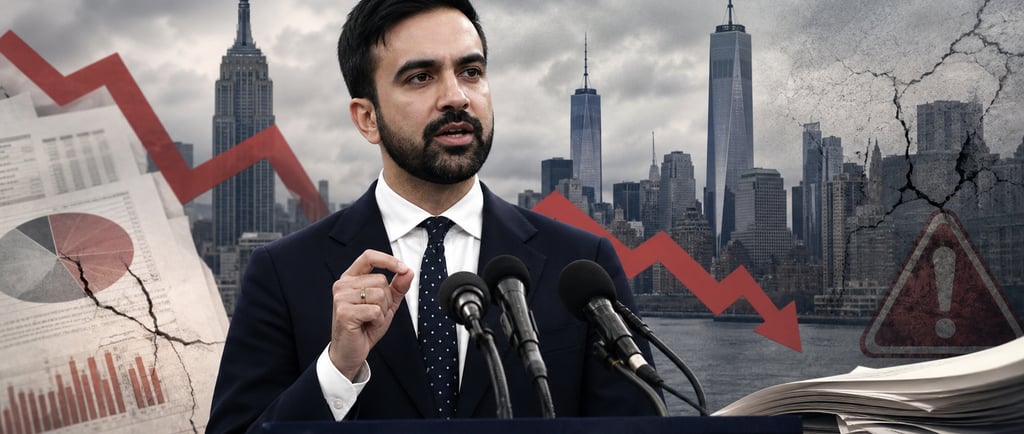
New York City, one of the world's most important cities, has entered the center of a new political and economic crisis after Mayor Zohran Mamdani stated that the city is facing a budget crisis of historic magnitude. The statement reignited the debate about public spending, tax increases, fiscal responsibility, and the risk of the largest metropolis in the United States repeating past mistakes.
Although many commentators use the expression "bankruptcy of New York," technically the city has not formally filed for bankruptcy. What exists, so far, is a severe fiscal crisis, with a billion-dollar deficit, pressure on the budget, and the need for new sources of revenue to meet the legal obligation to approve a balanced budget. According to the city government itself, Mamdani declared in January that New York faced a $12 billion shortfall in the fiscal years 2026 and 2027, attributing part of the problem to the previous administration of Eric Adams.
What did Mamdani say?
In an official statement, the New York City government stated that the city faces a fiscal emergency caused by years of mismanagement, underfunding of essential services, and an imbalance between what the city sends to New York State and what it receives back. Mamdani said that New York faces a “massive fiscal deficit” and that the crisis demands an honest response.
In April 2026, Mamdani and City Council President Julie Menin again pressed New York State for help. According to NBC New York, the two advocated for a package that includes more state aid and tax changes capable of generating nearly $1 billion in additional revenue for the city.
Mamdani's most important statement was direct: New York, according to him, would not be able to close the deficit solely through internal savings. For the mayor, it would be necessary to create new revenue and redefine the fiscal relationship between the city and the state.
Is the city really bankrupt?
The most accurate answer is: not formally, but the fiscal warning is serious.
In the United States, a formal municipal bankruptcy occurs through Chapter 9, a mechanism used by municipalities in financial difficulty to renegotiate debts with judicial protection. According to US federal courts, Chapter 9 serves to protect financially pressured municipalities while they develop a plan to adjust their debts.
New York, however, has not announced a Chapter 9 filing. What exists is a serious budget crisis, with a billion-dollar deficit and a political dispute over who should foot the bill: wealthy taxpayers, corporations, the state, spending cuts, or future generations of residents.
Furthermore, the city has specific fiscal requirements. The New York City Comptroller's office states that the city's budget must be balanced according to GAAP accounting standards and that the city must maintain a regularly updated four-year financial plan.
The Size of the Problem
The city government itself states that the inherited deficit could reach US$12 billion in fiscal years 2026 and 2027. Mamdani also stated that the current budget gaps are larger than those faced during the Great Recession and that some deficit projections exceed the pre-pandemic ten-year average by more than 300%.
This scenario puts the municipal administration under intense pressure. New York needs to maintain essential services, pay obligations, preserve market confidence, and at the same time fulfill political campaign promises that may require new spending.
According to NBC New York, Mamdani does not intend to revise his expectations for fulfilling campaign promises, even in the face of a multi-billion dollar deficit.
Mamdani's Strategy
Mamdani's response involves three main fronts: seeking more state aid, increasing revenue, and preventing the crisis from being resolved solely through cuts in public services.
One of the proposals involves altering the tax credit known as Passthrough Entity Tax Credit, reducing refunds for certain taxpayers and generating nearly $1 billion in additional revenue for the city. Mamdani also advocates restructurings related to pension obligations and relief in mandates to reduce school class sizes, measures that, according to his team, could help close part of the deficit.
Critics, however, argue that these solutions could push costs into the future and repeat practices that contributed to New York's fiscal crisis in the 1970s. The central debate is whether the city needs more revenue, more cuts, structural reforms, or a combination of the three.
The political risk
New York's fiscal crisis has ceased to be merely an accounting problem. It has become a national political battle.
For the left, Mamdani is trying to protect workers, public services, and low-income families from deep cuts. For his critics, the crisis reveals the risk
Opinion;
Throughout history, the left and communists have never been good at management and finance. Who would have thought that someone like that would cause financial problems? Does nobody learn anything from history?